Why does a Moray lawn need feeding differently?
Acid soil brings its own problem. Grass will grow on it, but so will moss, and moss is better at it. Add a dark, damp Moray winter and the north side of a house and the moss has everything it needs; my guide to moss, patches and other lawn problems in Moray goes into the causes.
Then there is June. On the Firth coast the grass can be under drought stress while the west of Scotland is still soaking, and a lawn pushed into soft, leafy growth by too much nitrogen in April suffers most when the dry weeks come. The feeding therefore has to be little and often, with products that suit a soil that leaches, on a timetable that respects a season that starts late and dries out early.
What do feed, weed and condition mean?
Three separate jobs done on the same visit. Feed is fertiliser. Weed is selective weed control. Condition is the range of products that look after the soil and the plant rather than pushing growth. What changes between spring and autumn is the balance of the three.
Feeding
A lawn fertiliser carries three main nutrients. Nitrogen drives leaf growth and colour; potassium (potash) supports the general health and hardiness of the plant; phosphorus helps the roots. My rule of thumb from years of greenkeeping is higher nitrogen in spring when the grass wants to grow, less of it in summer, phosphorus in autumn to help the roots prepare for winter, and potassium with every feed. The feeds we use are granular and organic-based, meaning slow-release fertilisers built on organic material rather than a quick-acting salt, so the lawn takes the food up steadily between visits rather than in one rush.
Weed Control
Selective weed control is a product that kills broad-leaved weeds (daisies, dandelions, clover, plantain and their relatives) while leaving grass unharmed, because it acts on broad-leaved plants and not on grasses. It goes on only where weeds are present and only when they’re growing, because a dormant weed takes nothing in. The products are professional ones, and
anyone using a professional plant protection product must hold a recognised certificate; our team hold the NPTC PA1, PA2 and PA6a certificates that cover safe handling, boom spraying and knapsack spraying.
Conditioning
These are the treatments that make the lawn a harder place for moss and disease to get going and an easier place for grass roots to work. We use a variety of conditioners through the year to help with moss control, disease control and general plant health, seaweed among them, and which ones go on depends on the season and on what the lawn is telling me when I walk it. That is not something I can write down as a fixed list, because a shaded, mossy lawn and a dry, open one don’t need the same thing in the same month. It is part of what we agree when I come out to look.
None of the three works well on its own for long. Feed without weed control grows bigger daisies. Weed control without feed leaves bare gaps where the weeds were, which moss fills. That is why the visit does all three, and why the year is planned as a sequence.
What happens through the year on a treatment programme?
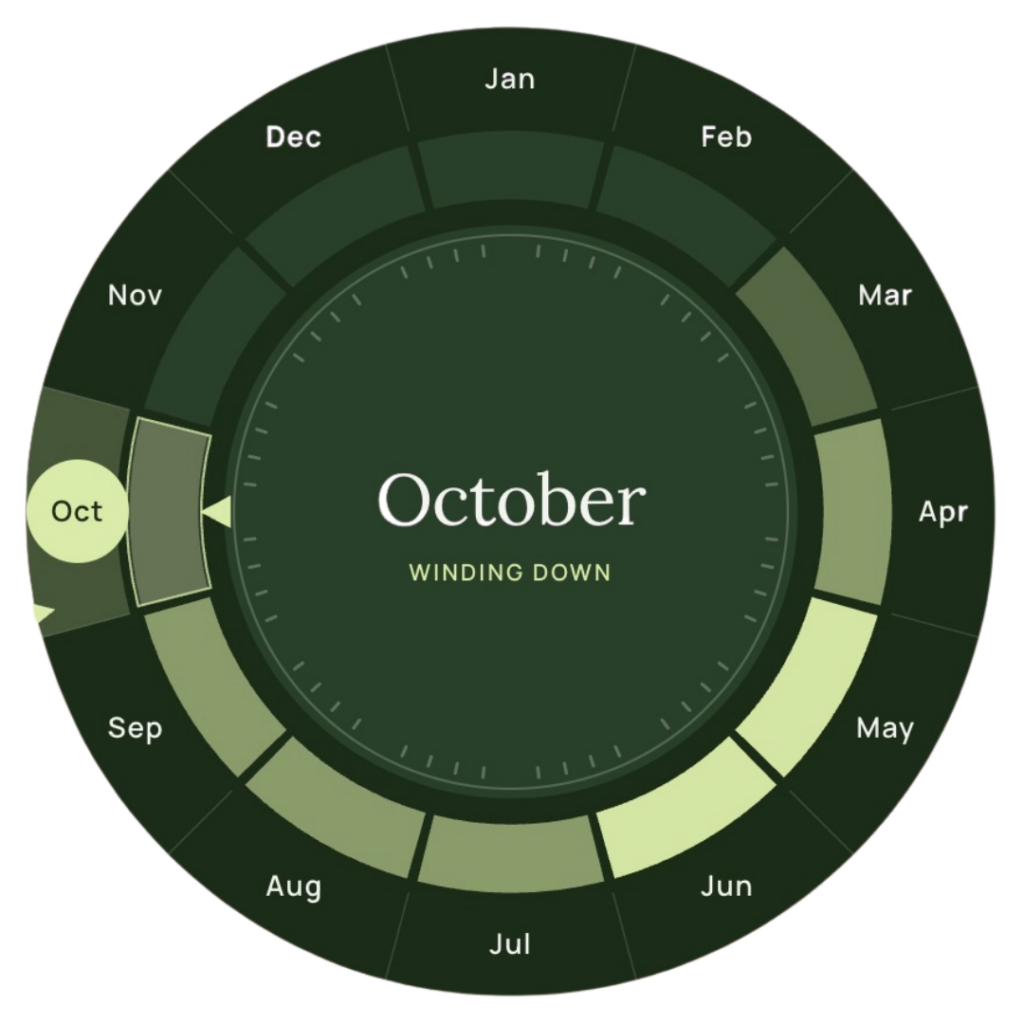
Four treatments roughly eight weeks apart from spring to autumn, with the scarifying and aeration visit in September, is the rhythm. The first goes on once the grass is growing, which on the coast is April in a normal year, and the last is the autumn feed in October. The dates move a fortnight either way with the weather, and that judgement is the reason there’s a greenkeeper attached to the programme rather than a calendar.
The eight-week gap is that greenkeeper’s rhythm brought home. Golf greens are fed little and often because steady growth is stronger growth, and a slow-release granular feed has roughly run its course by the time the next one goes on. I adapted and developed the programme from the green-keeping world, and the calendar is where that shows most.
Spring
The first treatment waits until the grass is visibly growing. The RHS gives the UK-wide window for a spring feed as
mid-spring, usually late March to April, while the lawn is actively growing; on the Moray coast that is nearly always the April end of it, and feeding cold, wet ground in March does nothing except feed the moss. The spring feed carries the most nitrogen of the year, and the first round of weed control goes on as the weeds start to grow.
Early Summer
Nitrogen eased back. The lawn is heading into the driest weeks of the year, and soft growth is the last thing it needs. Weed control continues where needed, and on the Premium and Plus levels the Drought Assist visits start around now (more on those in the watering section).
Late summer
A balanced feed to bring the lawn back after the dry spell and set it up for the autumn work. Growth has usually returned with the rain, so this is often the visit after which the lawn visibly recovers.
Autumn, After the Scarifying
A different product altogether. An autumn feed is low in nitrogen, so it
encourages root growth through winter rather than leafy growth, with the phosphorus and potassium that harden the plant for the cold. Leafy growth in November invites disease. Roots carry a lawn through a Moray winter and into a quick start in April.
Between the late summer and autumn treatments sits the September scarify and hollow-tine visit, which every level of the programme includes. Scarifying rakes out the thatch (the layer of dead grass and moss between the green blades and the soil), and hollow-tine aeration punches out small plugs of soil so air, water and the autumn feed reach the roots. It is the most important visit of the year on a moss-prone coastal lawn and it has its own guide to scarifying, aeration and overseeding in Moray. The Moray Garden Calendar page shows where every visit sits, month by month, and the programme section below covers what the Premium and Plus levels add.
What happens on the day of a treatment?
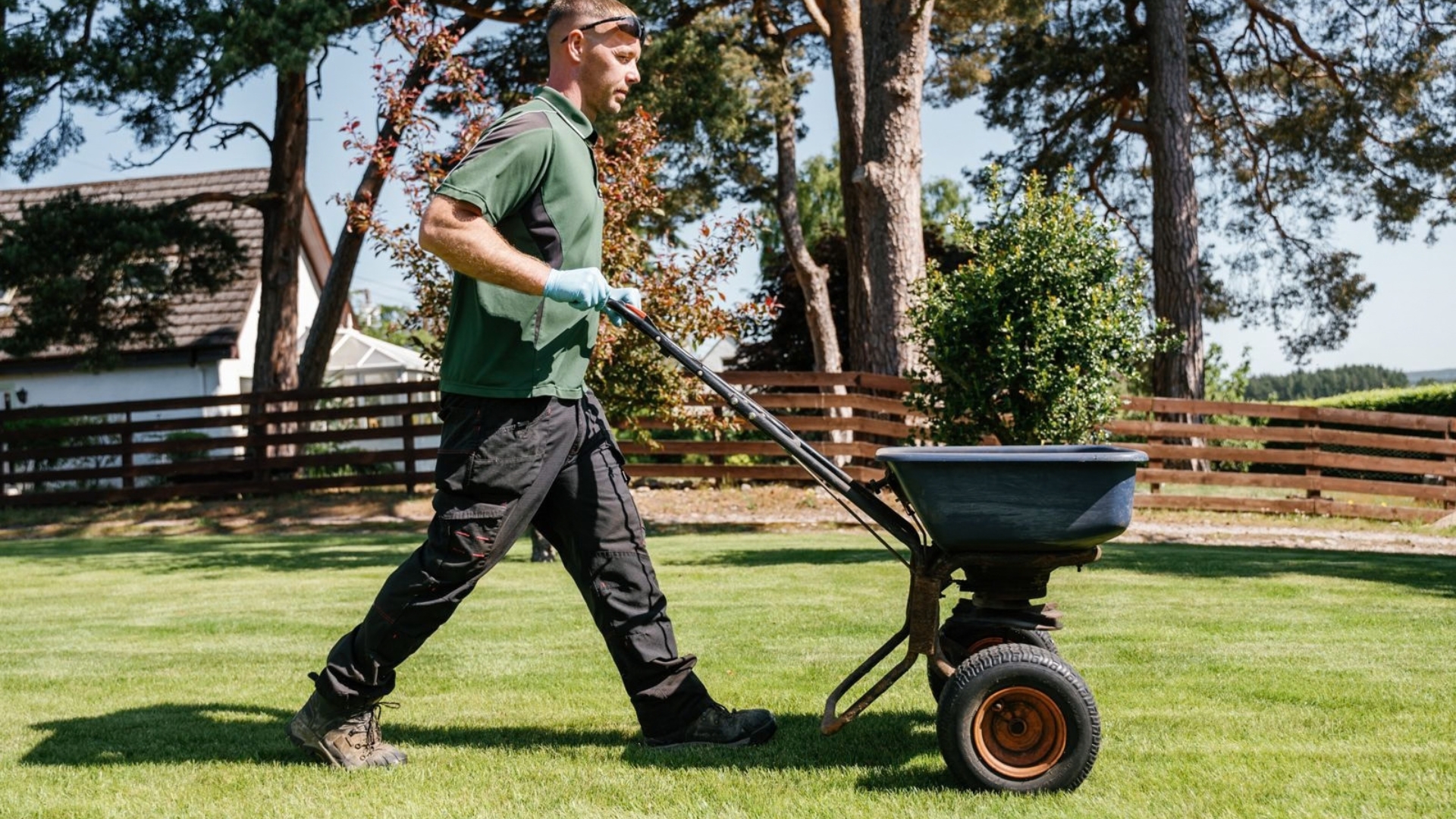
You don’t need to be in. We arrive, walk the lawn before anything goes on it, choose the rate and the products for what we find, apply them evenly with a calibrated spreader or sprayer and leave you a note of what was done and what to do next. The whole visit is usually shorter than people expect.
The walk round is the part most people never see, and it is where the programme earns its keep. Is the lawn dry enough to spray, has the moss thickened on the shaded side since last time, is that yellow patch hunger or leatherjackets? The product and rate follow from the answers, so two lawns in the same street may get slightly different treatments on the same day.
My two maxims after any treatment haven’t changed in 12 years. Keep off the lawn for the first one to two hours, and that includes the dog. Don’t cut it for the first three to four days. Occasionally we’ll ask you to water a product in to help it work, and if a product needs anything beyond those two rules, the note will say so.
What should you expect to see, and when?
A greener lawn within a fortnight or so of a spring or summer feed, weeds twisting and browning over the weeks that follow, noticeably less moss after the first autumn’s scarify and hollow-tine, and a thicker sward through the second year as the grass fills the space the moss and weeds used to hold. None of that is a guarantee; it is what happens to a lawn on the programme when the weather does what it usually does.
The honest bit is the timeline. The first season gets rid of what is there. The second is when the lawn starts to look like it belongs to someone. A lawn that has been mossy for ten years doesn’t come right in one summer.
Some things also go the wrong way before they go right. A lawn looks worse for a few weeks after scarifying, because the moss and dead grass that were padding it out have gone and the gaps show. In a dry June the lawn will still go brown; on a fed lawn with deeper roots it goes brown later and comes back quicker. Neither means the programme has failed.
Rather have this done? Ask me for a lawn quote and I’ll come out and measure the lawn.
Should you water a lawn in a Moray dry spell?
If you do decide to water, do it properly or not at all. My rule for a domestic lawn is ‘one inch once a week’. Stand a straight-sided jar under the sprinkler with a line marked an inch up from the bottom, time how long it takes to fill to the line, and use that time from then on. Anything past the line is water running through sand to nowhere. The once-a-week part is as important as the inch: filling the soil and then letting it dry from the top down sends the roots deeper, and deeper roots cope better with the next dry spell. A little every evening does the opposite.
Water in the morning where you can; evening watering leaves the grass wet overnight, which suits disease, and midday sun wastes most of it. Keep the mower high while it’s dry and hold off feeding until growth returns, because fertiliser on a stressed lawn does more harm than good.
Drought Assist is the programme’s answer for the lawns that suffer most. On thin sand the problem is often not that rain never comes but that the top few millimetres have dried so hard that a shower runs off. Wetting agents and other drought-relief products change that, so the water that does fall soaks in and stays where the roots can reach it, and where a lawn has sealed over we’ll spike or slit it to open the surface. We can’t water for you, but on the lawns that dry out first it saves a lot of time and water. It is built into the Premium and Plus levels and can be added to Standard; whether your lawn needs it is one of the things I look at on the visit, because a shaded lawn and a south-facing one in full coastal sun are different propositions in June.
Do it yourself or have it done?
You can do a decent job of feeding a lawn yourself if you buy the right product for each season, calibrate a spreader, walk the lawn in straight overlapping lines four or five times a year and keep on top of the weeds. Plenty of people enjoy that and some are very good at it. What a programme buys is the judgement, the professional products and the certainty that it happens on time.
The mistake I see most is uneven application. Fertiliser that lands twice on one strip and not at all on the next gives you dark green stripes beside yellow ones, and where it lands too heavily it burns the grass outright. Putting it on evenly at the rate on the bag is the one thing you must get right, and it is harder than it looks on an awkward-shaped lawn. (The turn at the end of each run is where the doubling happens.)
Then there are the products and the timing. The slow-release fertilisers, conditioners and selective weed controls we use are professional lines, and the weed controls are only sold to certificate holders. A weed control put on in a cold week does little; a feed put on before a dry fortnight can do harm. Doing it on the right week, five times a year, for years, is the part most people stop doing after the second season.
If you like mowing, keep mowing. A good many of the lawns we treat are cut by their owners. We do the treatments and the autumn work, they do the cutting, and the Mowing Programme is there for people who would rather have their Saturdays back.
On cost, three things decide it: the size of the lawn, which we measure rather than guess; the level of programme, which sets the number of visits; and the fact that it’s paid as one even monthly amount across the year rather than a bill per visit, so January costs the same as June. What the monthly figure comes to for your lawn is a question for a visit, because two lawns that look the same size from the gate rarely are, and a lawn that needs leatherjacket control or a rebuild before it needs feeding is a different conversation from one that just needs looking after.
How this works on the Lawn Programme
I come out, walk and measure the lawn, and put a written programme and a monthly price in front of you. The lawn falls into one of three size bands (under 200 square metres, 200 to 600, or 600 to 800), you choose one of three levels, and the year is then mapped out in advance. Lawns larger than 800 square metres, or gardens where the lawn is only part of a bigger job, go to Bespoke Grounds Care instead.
Standard is four feed, weed and condition treatments about eight weeks apart through the growing season, plus the September scarify and hollow-tine visit, with the cores lifted and taken away and the lawn blown clean. For most medium lawns on the coast this is the level that gets the moss under control and the grass thickening.
Premium adds a fifth treatment, a lighter spring scarify as well as the autumn one, and the Drought Assist visits through the dry months, so the lawn is looked after at both ends of the year and through the middle of it.
Plus runs six treatments and adds a late-spring overseed and top dressing with an organic soil conditioner. Overseeding sows new grass into the thin areas; top dressing spreads a fine layer of conditioner over the surface to level it and hold moisture around the seed, which on sandy soil is the difference between seed that takes and seed that dries out.
What is not included needs saying plainly. Mowing is a separate programme. Leatherjacket control, lawn rebuilds and the other Programme Extras are quoted when a lawn needs them, and if I think yours does I’ll say so at the visit rather than let you pay for feeds that can’t work until the grubs or the levels are dealt with. Individual treatments can be booked, but a single feed doesn’t change a lawn, and I’d rather tell you that than sell one. Payment is one monthly amount, the same every month, with the visits, the level and any extras set out in writing before anything starts. The Lawn Programme page sets out the three levels side by side and is where to request a quote.
Where we work and what we take on
Our lawn treatment territory is a triangle from Cullen in the east to Nairn in the west and Glenallachie in the south, with Elgin and the towns around it at the centre; we also take on a little work around Keith. The programmes are built for medium-to-large domestic lawns and gardens, the sort that give a team something to get their teeth into. Single cuts, one-off tidies and small one-off jobs are not what the programmes are for, and I would rather say that here than on the phone.
Questions I get asked about lawn treatments
When should I feed my lawn in Scotland?
When the grass is growing, which on the Moray coast usually means April for the first feed. Feeding in March, while the soil is still cold, does nothing for the grass. After that, a feed roughly every eight weeks through to October keeps pace with the season. The Moray Garden Year page shows the usual months for each visit.
Can you feed a lawn in winter?
Not as a rule. Grass is barely growing between November and March, so most of a winter feed is wasted or washed through the sandy soil here. There are two exceptions: a light green-up towards the end of winter, and new turf or seed that needs establishing. The autumn feed in October, which builds roots rather than leaf, is the last routine treatment of the year.
How long after a treatment can I mow, and can the dog go out?
Leave the mowing for three to four days, and keep everyone off the lawn, dog included, for the first hour or two. Those are my two rules after every visit and they’re on the note we leave you. If a product needs anything more than that, or wants watering in, the note will say so.
What if it rains straight after a treatment?
A shower is usually a help, not a problem. Granular feeds want watering in, and light rain after a visit does the job for you. Heavy, prolonged rain straight after a liquid weed control can reduce how well it works, and if that happens we’ll look at the lawn on the next visit and treat again where the weeds have come through. We check the forecast before we come.
Does a treatment programme work in a wet year?
Yes, though the lawn behaves differently. A wet summer means less drought stress and more growth, so the grass uses the feed well and the moss pressure comes earlier in autumn. The September scarify and hollow-tine visit becomes more important, not less, because compacted, waterlogged soil is where moss wins. I adjust the rates and timings to the year rather than following the calendar blindly.
Do you do one-off treatments?
We can, but I’ll tell you honestly what one visit will and won’t do. A single feed greens a lawn up for a few weeks. It doesn’t deal with the thatch, the compaction or the acid soil that let moss back in, which is the work the programme is built around. If the lawn has been struggling for a while, the Standard programme is the starting point.