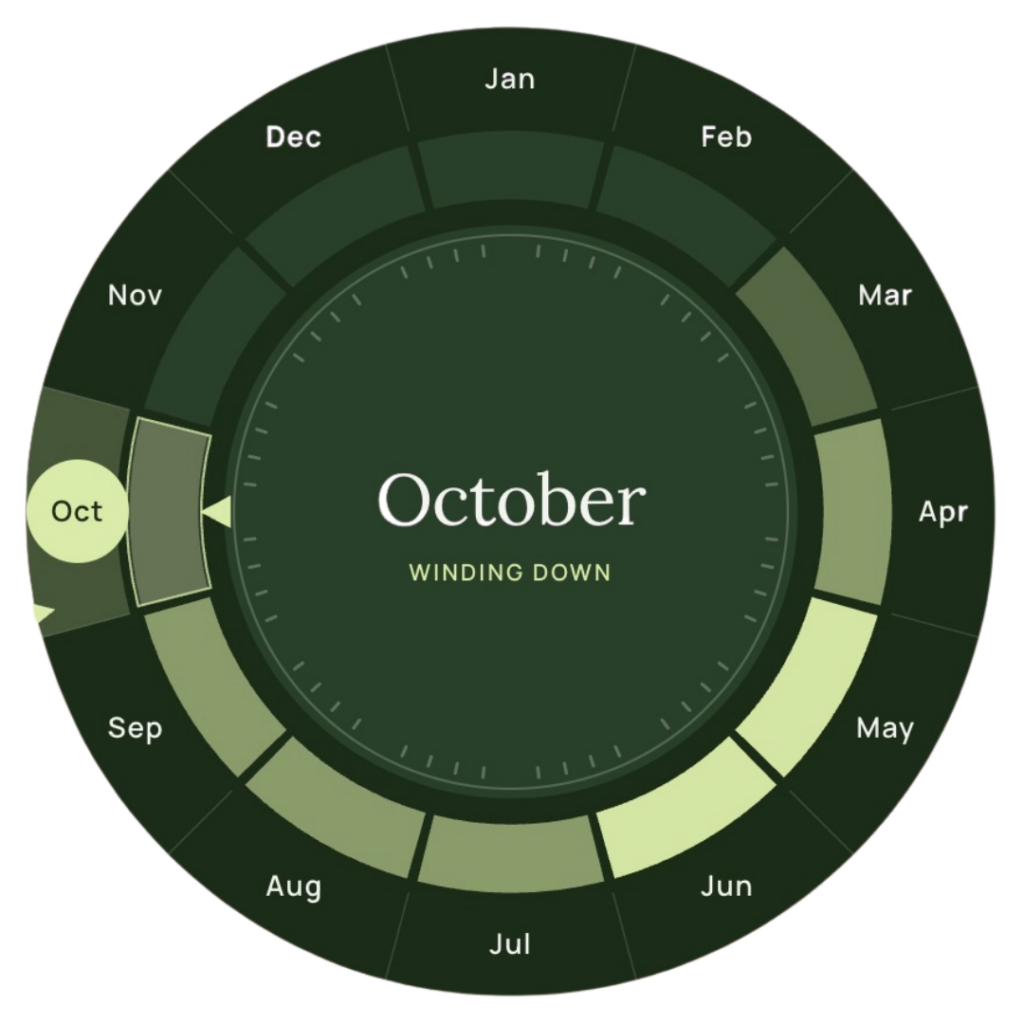
Why is the window tighter on the Moray coast?
Because our season is short at both ends and the driest weeks of the year fall in late spring. A scarified lawn can only heal while the grass is growing and the soil is moist, and on this coast there is one month a year when both are reliably true.
So why not spring, when the lawn is waking up and has the whole summer ahead of it? Because on this coast the summer starts with the driest spell of the year. A lawn scarified hard in April on thin coastal sand is bare soil facing a dry May and June, and it scorches and dries out rather than recovering. A light spring pass on a lawn already in decent order is a different matter, and that is how it runs on the Premium and Plus levels. The heavy work waits for September. Winter is out altogether: a lawn scarified in December looks damaged until growth starts again in spring.
What is scarifying, and what does it take out?
Scarifying is an intensive raking of the lawn by a machine with fast-spinning blades, and what it takes out is thatch and moss. Thatch is the layer of dead grass, old clippings, moss and debris that builds up between the green blades and the soil. A little is normal. Once it thickens into a spongy mat, water and feed sit in it instead of reaching the roots, moss settles into it, and the lawn starts living in its own litter.
The way we do it is to pass the scarifier over the lawn twice, in two different directions, so the blades cross in a diamond pattern. One pass lifts what sits in the direction of travel; the second lifts what the first laid flat. It takes longer and it is the difference between a lawn that has been scarified and one that has been tickled.
Then the debris is lifted, taken away for recycling and the lawn is blown clean. The pile is nearly always bigger than people expect. (If you are doing it yourself, bring more bags than you think.) What is left behind is a thinner, scruffier lawn with the soil showing through, and that is the point: the surface is open for the hollow tines, the seed and the dressing that follow.
What does hollow-tine aeration do?
It punches out thousands of small plugs of soil, each about the size of your little finger, so that air, water and feed can get down to the roots and the soil can breathe. A hollow tine is a short steel tube; a solid tine or spike is a rod. The hollow one removes a core and leaves a hole that stays open, which is why it does more for a compacted lawn than a spike does.
We run the hollow tines over the lawn in a single pass to keep the holes evenly spaced, then lift the cores and take them away with the thatch. Left on the surface they break down into a muddy smear; lifted, you can hardly see the holes once the grass closes over them.
The RHS reckons that for most lawns aerating every two to three years is enough and that
hollow-tining is best done every three to four years. On the programme I hollow-tine every lawn every September, and that is my judgement rather than RHS advice. The lawns I am asked to look at are nearly always the compacted, mossy ones, the autumn feed and conditioners go straight into the open holes rather than sitting on top, and a yearly pass means no single year has to be a hard one. If a lawn reaches the point where it does not need it, I’ll say so at the visit.
Season decides the tine. If you are wondering when to aerate a lawn in Scotland, the answer for hollow tines is the same September as the scarifying, with spring as the second option and winter acceptable as long as the ground is not saturated. In summer, if a lawn has sealed over in a dry spell, the right tool is a solid tine or slitter, watered in afterwards or the grass round each hole scorches. That summer spiking is part of what Drought Assist does on the Premium and Plus levels; my guide to lawn treatments through the Moray year covers the dry-spell side properly.
Scarify or aerate first? The order of work
Scarify first, then aerate, then seed, then dress, then feed. Each step opens the lawn for the next: the scarifier clears the thatch so the tines reach soil, the tines open the soil so seed and dressing have somewhere to go, and the feed goes on once there is bare ground to take it. Reverse any pair and you undo the earlier job; scarifying after you have aerated, for instance, drags the cores back into the holes you just made.
The same order answers the whole family of ‘how long after scarifying should I’ questions, so here it is as a timeline for a programme lawn in September.
Scarify. Day one. Two passes in different directions; debris lifted and removed; lawn blown clean.
Hollow-tine. Day one, straight after the scarifier. A single pass; cores lifted and removed.
Overseed. Day one, where the lawn is thin, and routinely in late spring on the Plus level. Seed placed into the opened surface.
Top dress. Day one, after the seed. Dressing spread thinly and worked in so it does not smother the grass.
Recovery treatment. Within the following week or two. The feed team’s visit to get the grass filling the gaps, with the regular feed if one is due.
First cut. About a week after the feed team. Tops off only, clippings collected.
Normal mowing. From the second cut, bringing the height down a notch at a time.
If you are doing it yourself, keep the same order and the same gaps. Seed on the day you scarify, while the surface is open; feed within a week or so; mow a week after that. Leave the seed a fortnight and the surface has started to close and the moss has had first pick of the bare soil.
What are overseeding and top dressing?
Overseeding is sowing new grass seed into an existing lawn to thicken a thin one or bring an old one back, and top dressing is spreading a thin, even layer of soil, sand or compost over the surface and working it in. On a domestic lawn the dressing does two jobs: it improves the soil the grass sits in and it beds the seed.
Seed only grows where it touches soil. Scatter it over a lawn that has not been scarified and most of it sits on the thatch, dries out and feeds the sparrows. Our overseeder places the seed into the opened surface rather than throwing it across the top, and the dressing that follows holds moisture around it. On the sand along this coast that dressing is the difference between seed that takes and seed that doesn’t, which is why we use an organic, seaweed-based compost rather than plain sand. Sand on sand improves nothing. A compost dressing puts some body into a thin soil and gives the seedlings something to root into.
The seed then gets a starter feed weighted towards phosphorus, the nutrient for root growth, with a wetting agent to help water soak into the dressing and seaweed conditioners for the young plant. Those are the products as we use them now; what goes on any one lawn is agreed at the visit.
On the Plus level this happens in late spring, usually May, after the lighter spring scarify has opened the surface. The RHS prefers early autumn for sowing a lawn from scratch, because
seedlings sown then establish before the hard frosts, while spring-sown grass can put its energy into flowering rather than rooting, and for a brand-new lawn here I’d agree. Overseeding an established lawn on the programme is different. In September the lawn is busy recovering from the heavy scarify and hollow-tine; a May sowing goes into a lawn that has only been lightly opened, with the whole season to thicken and the Drought Assist visits to carry it through the dry weeks. It needs watering, and I’ll say so plainly at the visit, because overseeding in May on this coast without water is money on the ground.
What will the lawn look like afterwards, and for how long?
Worse. Thinner, browner, striped and with soil showing, for a few weeks, and then better than it was. ‘Lawn looks terrible after scarifying’ is typed into Google every September by someone who has just done the right thing. The moss and dead material that were padding the lawn out have gone, and the gaps they were hiding are now visible. The grass was always that thin; you just couldn’t see it. From here the lawn thickens as the surviving grass spreads sideways into the space, which is what the recovery treatment is for.
Rather have this done? Ask me for a lawn quote and I’ll come out and measure the lawn.
After scarifying and hollow-tining
On the programme the feed team follows the scarifying with a recovery treatment, and your regular feed if one is due, so there is nothing you need do straight away. A week after the feed team has been, give the lawn a first cut that takes the tops off, no lower, then go back to your normal cutting. Hollow-tining follows the same rules.
After overseeding
An overseeded lawn asks more of you. Keep off it as much as you can and don’t cut it until the seed has sprouted and the young grass is at least two to three inches tall. The first cut takes the tops off with the clippings removed; leave it another couple of weeks; then bring the height down slowly over the following cuts. Watering makes or breaks it. For the first couple of days give the lawn about an inch of water a day to soak the soil through, then switch to little and often, enough to keep the soil around the seed moist, which means watching the seedlings and the forecast rather than the clock. Once the seedlings are about two inches tall, go back to one inch once a week. The mowing guide for Moray lawns covers heights and first cuts in more detail.
When is scarifying not enough?
When there is more moss than grass, when the surface is full of hollows that no dressing will level, or when leatherjackets have eaten the roots and the grass lifts like a carpet. Scarify a lawn like that and you are left with soil and a few tufts. It needs rebuilding, and I’d rather tell you that at the visit than scarify it and send you a bill for the bare ground.
A rebuild strips the lawn back, puts the levels right, improves the soil and starts the grass again from seed or turf, then goes onto the programme so it stays that way.
Seed or turf?
Hire a machine or have it done?
You can hire a scarifier for a weekend and do a reasonable job on a medium lawn, provided you pick the right week, set the depth sensibly, go over it twice and have somewhere for the debris to go.
The depth setting is where hire jobs go wrong. Too shallow and you have combed the lawn; too deep and you have ploughed it, taking the crowns of the grass plants out with the thatch. A lawn scarified too deep in a week that turns dry is the one behind the search ‘can scarifying ruin your lawn’. Scarifying can’t, but scarifying badly at the wrong time can set a lawn back a season. Hollow-tining is harder still to hire well: the machines are heavy, the tines need to go in straight and the cores have to be lifted.
What you cannot hire is the sequence. A programme lawn comes back quickly because the scarify, the hollow-tine, the recovery feed and the autumn feed happen as one piece of work over a few weeks, by people who know what the lawn looked like in June and what it needs by October. That is why we don’t sell a scarify on its own; without the feeding behind it, a scarify opens the lawn up and then leaves it to the moss. On cost, two things decide it: the size of the lawn, which I measure, and the level of programme, which sets how many visits the year holds. The scarify and hollow-tine visit is inside the monthly amount on every level, not an extra on top.
How this works on the Lawn Programme
I come out, walk and measure the lawn, and put a written programme and a monthly price in front of you. Every level includes the September scarify and hollow-tine visit, with the debris and cores lifted and removed and the lawn blown clean. What changes as you go up the levels is how much renovation the year holds.
Standard
Standard is four feed, weed and condition treatments about eight weeks apart from April to October, plus the September scarify and hollow-tine. For a medium lawn that is thatchy and mossy but basically sound, this is the level that turns it round over a couple of seasons.
Premium
Premium adds a fifth treatment, a lighter scarify in spring as well as the full one in autumn, and the Drought Assist visits through the dry months, so the thatch is kept down at both ends of the year and the surface kept open through June.
Plus
Plus runs six treatments and adds the late-spring overseeding and top dressing described above. It is the level for a lawn that has gone thin and needs new grass in it.
What is not included
A rebuild is quoted separately as a Programme Extra because it is a different job from maintenance, and if your lawn needs one I’ll say so before anything else goes on it. Mowing is its own programme. We don’t book a one-off scarify, for the reasons above. Payment is one even monthly amount across the year, so September costs you no more than any other month, and the visits and level are set out in writing before we start. The Lawn Programme page sets out the three levels side by side, and the Moray Garden Year shows where the scarifying, overseeding and treatments fall month by month.
Where we work and what we take on
Our lawn treatment territory is a triangle from Cullen in the east to Nairn in the west and Glenallachie in the south, with Elgin and the towns around it at the centre, and we take on a little work around Keith. The programmes are built for medium-to-large domestic lawns, the sort that give a team something to get their teeth into. Single cuts, one-off scarifies and small one-off tidies are not what the programmes are for, and I would rather say that here than on the phone.
Questions I get asked about scarifying
Can I scarify my lawn in June?
Not on this coast. June sits in the driest stretch of our year, and a lawn opened up by a scarifier needs moisture to close over. Scarify in June and you are likely to be looking at scorched, bare stripes until the rain comes back. If the lawn is bothering you in June, raise the mower, hold off feeding and book the September work.
How often should a lawn be scarified?
Once a year, in September, is right for most lawns here. Lawns that build thatch quickly, or that are being brought back from heavy moss, get a second, lighter pass in late April or May, which is how the Premium and Plus levels run. More than that and you are taking out grass rather than thatch.
Does scarifying get rid of moss?
It gets rid of the moss that is there. It does not stop moss coming back. Moss returns to any lawn where the shade, damp, compaction and thin acid soil that suit it are still in place. Scarifying clears it, hollow-tining and feeding take away the conditions, and the lawn needs all three every year to stay ahead of it.
Should I kill the moss before scarifying?
It helps. Dead moss is dry and brittle and lifts out cleanly; live moss is springy and some of it stays put. If you are doing it yourself, treat the moss a fortnight or so ahead, let it blacken, then scarify. On the programme, what goes on before the autumn visit is set out for your lawn when I come to look at it. Whatever you do, lift what comes off rather than leaving it on the lawn, or you have spread the moss you were trying to remove.
How long does a lawn take to recover after scarifying?
A few weeks in a normal September, longer if the weather turns dry or cold straight afterwards. The lawn looks at its worst for the first fortnight, then the gaps start closing as the grass spreads into them and the recovery feed takes hold. By the time the autumn feed goes on in October it should look like a thinner version of itself rather than a building site, and by spring it should be thicker than it was before.
Do you take the debris away?
Yes, always. The thatch and the hollow-tine cores are lifted, taken away for recycling and the lawn is blown clean before we leave. Debris left on the surface smothers the grass underneath, spreads moss spores and looks terrible, which defeats the purpose.