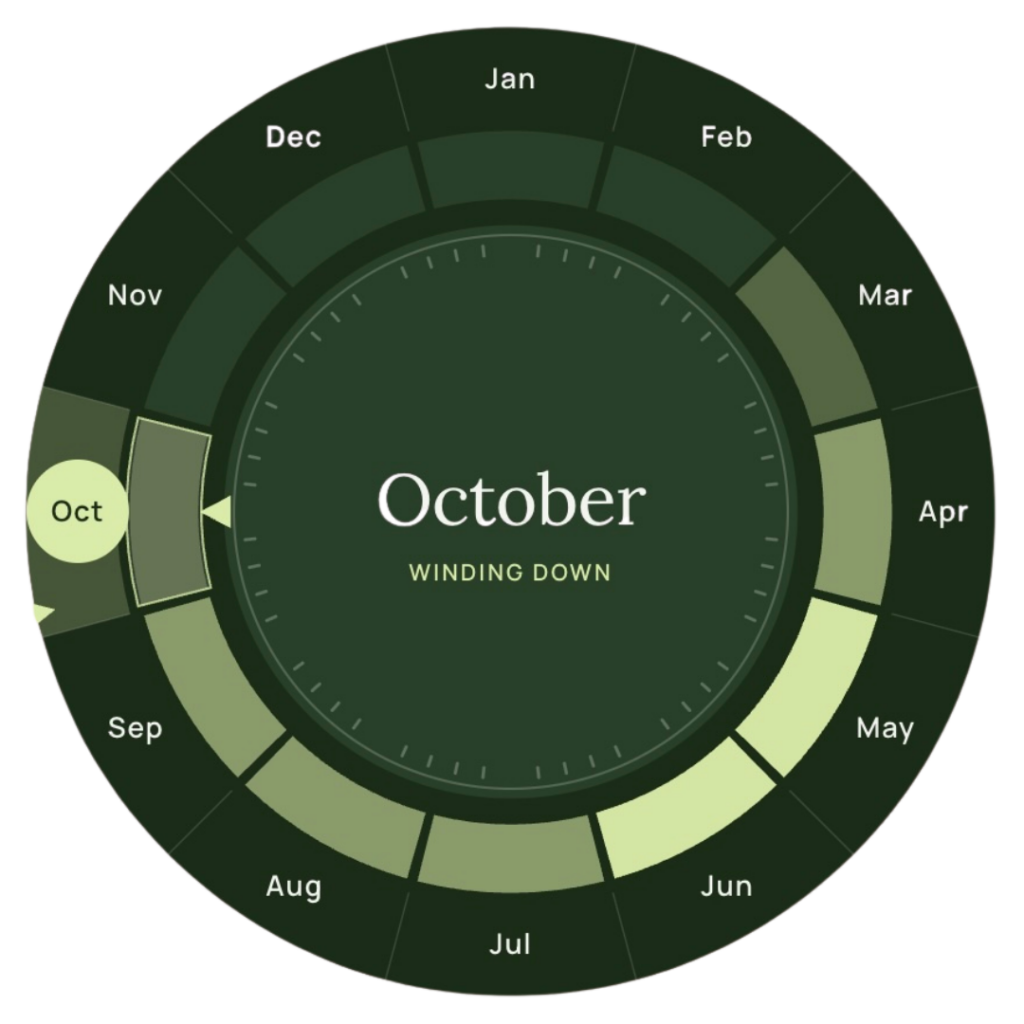

The Met Office climate averages for Lossiemouth record just over 53 days of air frost a year, with an average of 2.83 of them still falling in April. A Moray garden starts late and then grows fast, so for a medium or large garden here, a visit every fortnight from March to October, with two or three hours of real work each time and a few winter visits, keeps it in good order. Gardens that need to look their best all summer do well with weekly visits in May and June.
I hold NC, HNC, HND and Diploma qualifications in horticulture, the HND and Diploma with distinction, and I spent five years as a greenkeeper at Loch Lomond Golf Club. Our team has looked after gardens across Moray since 2014.
Garden maintenance in Scotland’s north east comes down to timing, from what happens on each visit and in winter to the bark on the beds, the paths and where the prunings go.
How often should a gardener come to a Moray garden?
Every two weeks from March to October suits most medium and large gardens in Moray. That’s the rhythm our Garden Programme runs on, with 18 fortnightly visits through the growing season. Monthly visits give weeds time to set seed in between, and weekly visits are rarely needed outside May and June.
Those two months are when gardens grow fastest. Met Office figures for Kinloss put average May sunshine at 197.8 hours, the brightest month of the year there on the 1991 to 2020 averages. That’s why our Premium level adds weekly visits in May and June, when a fortnight’s growth is a lot to catch up on.
Counting visits only tells you part of it. The gap between them decides whether each visit starts with gardening or with catching up.
Once the gap is settled, the next question is how long each visit should be.
Why does a whistle-stop tidy never quite catch up?
The fixed parts of a visit don’t shrink to fit. Unloading, a walk round to see what’s changed, clearing up and loading the van take much the same time on any visit, so on a short one they use up a bigger share of it. Two or three hours leaves room for the gardening.
Hours give a clearer picture than visits. On our Standard level, 18 visits with two hours of gardening time at each come to 36 hours between March and October. Premium’s three hours a visit come to 54, before the weekly visits in May and June and the winter work.
You see those hours in the jobs that need a proper run at them: lifting and dividing a crowded clump of perennials, cutting back a whole border in one go, edging every bed in the garden.
Hiring a gardener is easier when you know what to ask. Whoever you talk to, ours included, three questions tell you most of what you need to know:
-
How long will you be in the garden on each visit, and is that per person or for the team?
-
What gets done on a typical visit in May, and what in October?
-
Who takes the green waste away, and where does it go?
The second question has a different answer almost every month.
What happens on a visit, from first weeds to last leaves?
Each visit picks up the jobs that belong to that fortnight. Our Moray Garden Year sets out the garden maintenance schedule month by month.
Spring visits, March to May
March starts with edging beds, the first weeding, cutting back last year’s growth and tying in. April brings planting, dividing perennials, tying in climbers and the first proper tidy of the borders. In May it’s bedding, staking and the first flush of weeds.
Summer visits, June to August
June is deadheading, watering new plantings and staying ahead of the weeds. July adds summer pruning of early-flowering shrubs, and August brings the late-summer cutting back.
It’s nesting season too. The RSPB’s guidance on birds’ nests marks March to September as the main nesting season, and the Wildlife and Countryside Act 1981 makes it illegal, with certain exceptions, to deliberately take, damage or destroy a wild bird’s nest while it’s in use or being built. We check a hedge before we cut it, and if birds are going in and out, it waits until they’ve finished.
Autumn visits, September and October
September is the autumn tidy, with spring bulbs planted and borders cut back where they need it. October brings the last fortnightly visits of the season: leaves cleared, tender plants protected and beds put to bed.
Which of those fortnights would your garden miss most? If you’re unsure, start with May and June. Growth is fastest then, so a missed visit shows soonest.
Then October ends, the fortnightly visits finish, and it’s easy to assume the garden sleeps until spring. It doesn’t, quite.
What does a gardener do in winter?
Winter is for the structural work: pruning, clearing beds and the groundwork that puts a garden ahead of spring. On the Garden Programme, Standard includes two winter visits between November and February and Premium includes four.
Fruit trees are the classic winter job. The RHS guide to winter pruning apples says to prune while the tree is dormant, between leaf fall and bud burst, which is usually November to early March. Routine winter pruning, it says, should remove about 10 to 20 per cent of the canopy.
Tree and fruit tree pruning and one-off winter clear-downs are the two jobs we’ll book on their own, outside a programme. A clear-down is the job for a garden that’s grown away from you over a season or two.
Winter is also when the shape of a garden is easiest to see. With the leaves gone, crossing branches and overgrown shrubs stand out, and the cuts made in January are the ones you notice in June.
Pruned and weeded beds are then ready for the job that does the most for them on this coast.
Why do Moray beds love a good layer of bark?
The Moray coast is dry by Scottish standards, and a layer of mulch (any material spread over bare soil) holds moisture in the ground and keeps weeds down. The same Met Office records give Lossiemouth an average of 670.6 mm of rain a year, against a Scottish average of 1,572.65 mm, and March and April are its driest months.
Bark on a bed works like water stored ahead of time. 2026 showed the value of that. In July, SEPA’s water scarcity report put the River Lossie at Significant Water Scarcity, with the lowest flows in the river since 2003.
Depth is what makes mulch work. The RHS guide to mulching recommends a layer at least 5 cm deep, ideally 7.5 cm, applied when the soil is moist from winter rain, and advises waiting if the soil is very wet or frozen.
We put bark down in mid to late spring, over weeded, moist beds, so it holds water through the dry weeks ahead, or in autumn. (Order counts here: anything under the bark is harder to reach afterwards, so the weeding and pruning come first.)
Who keeps the weeds out of the cracks?
On both levels of our Garden Programme, we keep the paths and patios close to the house free of weeds as part of each visit.
When did you last walk up your own path the way a visitor would? Next time you come home, look at the cracks and edges before the borders.
Where a path needs weedkiller, the rules are clear. The HSE’s guidance on professional pesticide use says anyone using a professional product must hold a recognised certificate, or be working under the direct supervision of someone who does while training. Anyone applying products as a contractor, on land they or their employer don’t own, must hold a Level 2 award in the safe use of pesticides.
Our team holds NPTC PA1, PA2 and PA6a spraying certificates. NPTC is City & Guilds’ qualification brand for land-based work, and these three cover the safe use of pesticides and the equipment used to apply them.
All that weeding, cutting back and clearing leaves something behind.
What happens to the green waste?
That depends on the job and the programme you choose, and we agree it with you before the written quote goes out.
Scotland’s duty of care code of practice for waste says that, as a householder, you must make sure waste produced on your property only goes to a waste transporter registered with SEPA. It asks you to check the registration on SEPA’s public register and to ask where your waste is going. Highland Green is a SEPA registered waste carrier, so you can look us up the same way.
If you’d rather deal with some of it yourself, Moray Council’s garden waste permit costs £54 per brown bin for 2026-27, and extra garden waste can go to the council’s recycling centres free of charge.
Where the prunings end up is the one part of garden care the law follows all the way to the end.
Bringing all of that into one planned year is what our programmes are for.
How this works on the programme
Every Garden Programme starts with a visit. One of us walks the garden with you, then you get a written quote with the year’s visits laid out. The Garden Programme page sets out Standard and Premium in full, and the fortnightly visits run from March to October, adjusted to the year.
Standard
Two hours of gardening time a fortnight for beds, borders and shrubs, with a small lawn mown and the paths and patios around the house kept weed-free. Two winter visits prune, tidy and prepare the garden for spring.
Premium
Three hours a fortnight, the extra weekly visits in May and June (limited availability) and larger areas of lawn and paving covered. Four winter visits take care of pruning, bed preparation and groundwork.
The Complete Garden Programme
If you have a sizeable lawn as well as borders and hedges that all need regular care, the Complete Garden Programme brings lawn treatments, garden maintenance and mowing into one schedule, with hedges and trees where needed. I visit, walk the whole property with you and write the year’s schedule. It typically suits homes with lawns of 200 square metres or more.
If you only need two of the three parts, you’d take those two programmes side by side instead, and I’ll tell you which works out cheaper for the same result.
Additional services
Bark mulching, winter clear-downs, Regular Hedge Care and tree and fruit tree pruning are among the Additional Services on our Programmes page. Each is quoted in advance and added to your year.
One step ahead of the Moray seasons
A garden that seems to look after itself is usually one where nothing gets long enough to take over. That comes down to rhythm, and rhythm is far easier to keep than to win back.
The months ahead give you a head start. SEPA’s 22 October water scarcity report shows further recovery in many areas, though levels across the east remain very low for the time of year and ground conditions are still dry in parts of eastern Scotland. Soil moisture going into spring is worth holding on to.
January and February are the natural months to plan the year, ahead of the fortnightly visits starting again in March.
If you’d like your garden on that rhythm, tell us about it and one of us will come out, walk it with you and put the year in writing.
Questions about having a regular gardener
Do I need to be home when the gardener comes?
No. Your visits go in the diary and you hear from us before and after each one, so you’ll know when we’re coming and when we’ve been. If there’s anything we should know about getting into the garden, mention it when we visit to quote.
Will it be the same gardeners each time?
Wherever we can, yes. Our gardeners usually work in pairs, and we keep the same people on the same gardens, because knowing a garden is what lets the work build from one visit to the next. We can’t promise the same faces every time, with holidays and illness, but whoever comes works to the same plan.
Can I add hedge cutting to a Garden Programme?
Yes. Regular Hedge Care adds a scheduled trim once or twice a year, timed for the hedge and the nesting season, and it can be added to any programme.
Does the Garden Programme include mowing the lawn?
It includes mowing a small lawn as part of the visit. A larger lawn goes on our Mowing Programme, which runs alongside, and our guide to mowing a Moray lawn covers the first and last cuts of the year and the heights in between.
How much does a regular gardener cost?
It depends on the size of the garden, the planting and the level you choose, so we price each garden after visiting it. The year’s visits are priced once and divided into twelve equal monthly payments, so you pay the same in February as in July. Any extras are quoted and agreed before they’re added.
We look after private homes across Moray, including Elgin. Our garden and mowing programmes run from Cullen to Alves and up the Spey to Aberlour, and postcodes decide anything near the edge. We do not take on commercial, estate or contract work.